
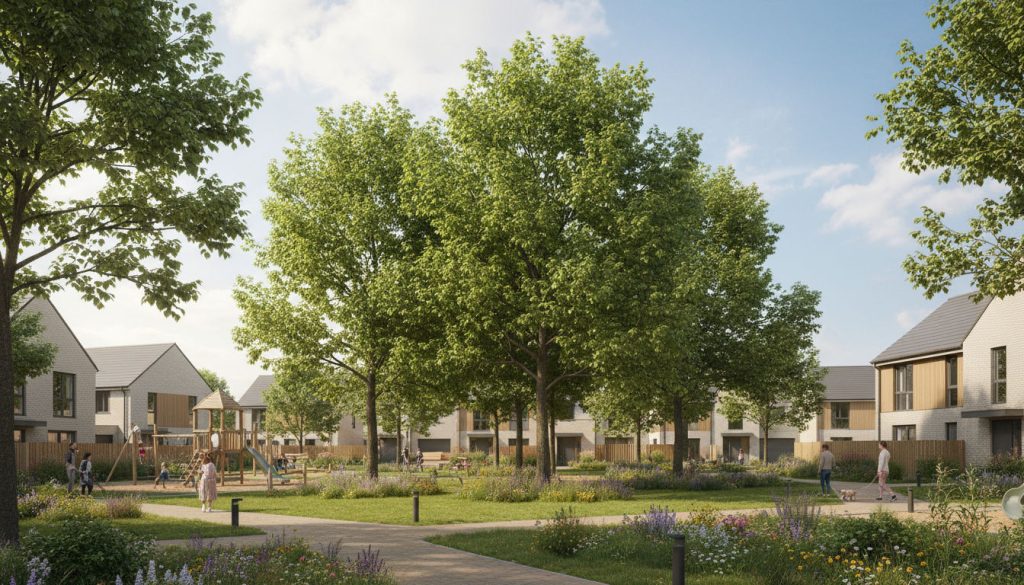
From A New Development Site To Established Landscape
A tree may take minutes to plant, but its success is shaped by decisions made long before it reaches the ground. On a new development site, careful planning can help trees establish, enhance the finished landscape and provide benefits for decades. Poor choices, by contrast, can lead to stressed trees, costly replacements or conflicts with buildings, roads and services.
Whether you are planning a private garden, a housing development, an estate or a public space, the key is to treat trees as part of the project from the outset, not as an afterthought.
Start with the site, not the tree catalogue
Before choosing species, take time to understand the site. Consider the soil type, drainage, exposure to wind, available sunlight and how the ground may change during construction. Conditions can vary considerably, so a tree that performs well in one location may struggle in another.
It is also important to identify existing trees and understand their condition, value and position. An experienced arborist can help assess which trees may be retained, where protection is needed and whether any work is required before development begins.
Make room for the tree it will become
A young tree can look small and manageable, but its mature canopy and root system may be extensive. When planning planting locations, consider the tree’s eventual height and spread, as well as its relationship to homes, roads, footpaths, boundaries and overhead wires.
Roots need suitable soil and enough room to grow. Think carefully about underground services, drainage, foundations and hard surfaces, and avoid placing trees in cramped spaces where they will be likely to cause problems later. Getting the location right at the beginning can reduce the need for heavy pruning or removal in the future.
Choose species for long-term success
The best tree is not necessarily the fastest growing or most striking one. Choose species that suit the site and the intended purpose. Some may provide shade or screening, while others offer seasonal colour, blossom, fruit or valuable habitat for wildlife.
Consider how the tree will cope with local conditions, including soil moisture, wind exposure and changing weather patterns. A diverse selection can also help avoid relying too heavily on a single species. For public and commercial developments, think about practical factors such as mature size, leaf and fruit drop, visibility and ongoing maintenance needs.
Protect retained trees during construction
Existing trees can be seriously damaged by routine site activity. Compacted soil, excavation, stored materials and vehicles can all affect roots, even when the trunk appears untouched. Once construction work begins, a tree that looked healthy may start to decline.
Include tree protection in the construction plan and make sure site teams understand the boundaries and restrictions. Where appropriate, an arborist can advise on protection measures and provide guidance in line with recognised arboricultural standards, including BS 5837. Protection should be in place before work starts and maintained throughout the project.
Give new trees a strong start
Good planting is about more than putting a tree into a hole. The ground should be prepared appropriately, the root system handled with care and the tree planted at the correct depth. Staking may be needed, but it should support the tree without preventing natural movement or damaging the trunk.
Watering is especially important while a tree establishes. A newly planted tree can struggle during dry periods, even if the weather has been mild. Agree who is responsible for watering, checking ties and guards, controlling competing vegetation and replacing any failed trees. Clear responsibilities help ensure that aftercare does not get overlooked once the building work is complete.
Plan maintenance beyond the handover
A successful landscape needs ongoing attention. Regular checks can identify problems such as damaged branches, poor growth, rubbing ties or signs of pests and disease while they are still manageable. As trees mature, occasional pruning may be needed to maintain clearance or address specific safety concerns.
Maintenance should be based on the individual tree and site, rather than a one-size-fits-all schedule. Any work involving tree removal or pruning should be assessed carefully. Before work begins, check whether permissions or restrictions apply to the site, and use qualified, insured professionals for the job.
Bring an arborist into the project early
Early arboricultural advice can help developers, councils, landowners and homeowners make better informed decisions. It can support tree selection, planting layouts, protection of existing trees and safe management throughout the project. Resolving potential conflicts on paper is generally easier than dealing with them once paths, buildings and services are in place.
Established in 1997, our team has supported customers across Lincolnshire, from domestic properties and local Parish Councils to estates, builders and developers. Our fully qualified and insured tree surgeons have the experience and equipment to manage projects of all sizes, from trimming problem branches to removing trees safely where necessary.
How to plan for trees that will thrive
With thoughtful planning, suitable species and proper aftercare, trees can become one of the most valuable parts of a new development. Start early, make room for future growth and seek expert advice when you need it and your landscape will have a far better chance of thriving for years to come.
Please do not hesitate to reach out to us if you would like to arrange an initial meeting to discuss your project.

